Announcement
Get Ready for INDUS CUP 2K26! | Dates: 5–10 January 2026 | Stand a Chance to Win Cash Prizes up to ₹10,00,000!...Read more Get Ready for INDUS CUP 2K26! | Dates: 5–10 January 2026 | Stand a Chance to Win Cash Prizes up to ₹10,00,000!
We are excited to announce the Indus Hackathon 2025, an exhilarating one-day event organized by the CSE Department of Indus University....Read more We are excited to announce the Indus Hackathon 2025, an exhilarating one-day event organized by the CSE Department of Indus University.
26th ISTE Faculty Annual State Convention will be held at Indus University on April 27, 2023....Read more 26th ISTE Faculty Annual State Convention will be held at Indus University on April 27, 2023.
Get Ready for INDUS CUP 2K26! | Dates: 5–10 January 2026 | Stand a Chance to Win Cash Prizes up to ₹10,00,000!...Read more Get Ready for INDUS CUP 2K26! | Dates: 5–10 January 2026 | Stand a Chance to Win Cash Prizes up to ₹10,00,000!
We are excited to announce the Indus Hackathon 2025, an exhilarating one-day event organized by the CSE Department of Indus University....Read more We are excited to announce the Indus Hackathon 2025, an exhilarating one-day event organized by the CSE Department of Indus University.
26th ISTE Faculty Annual State Convention will be held at Indus University on April 27, 2023....Read more 26th ISTE Faculty Annual State Convention will be held at Indus University on April 27, 2023.











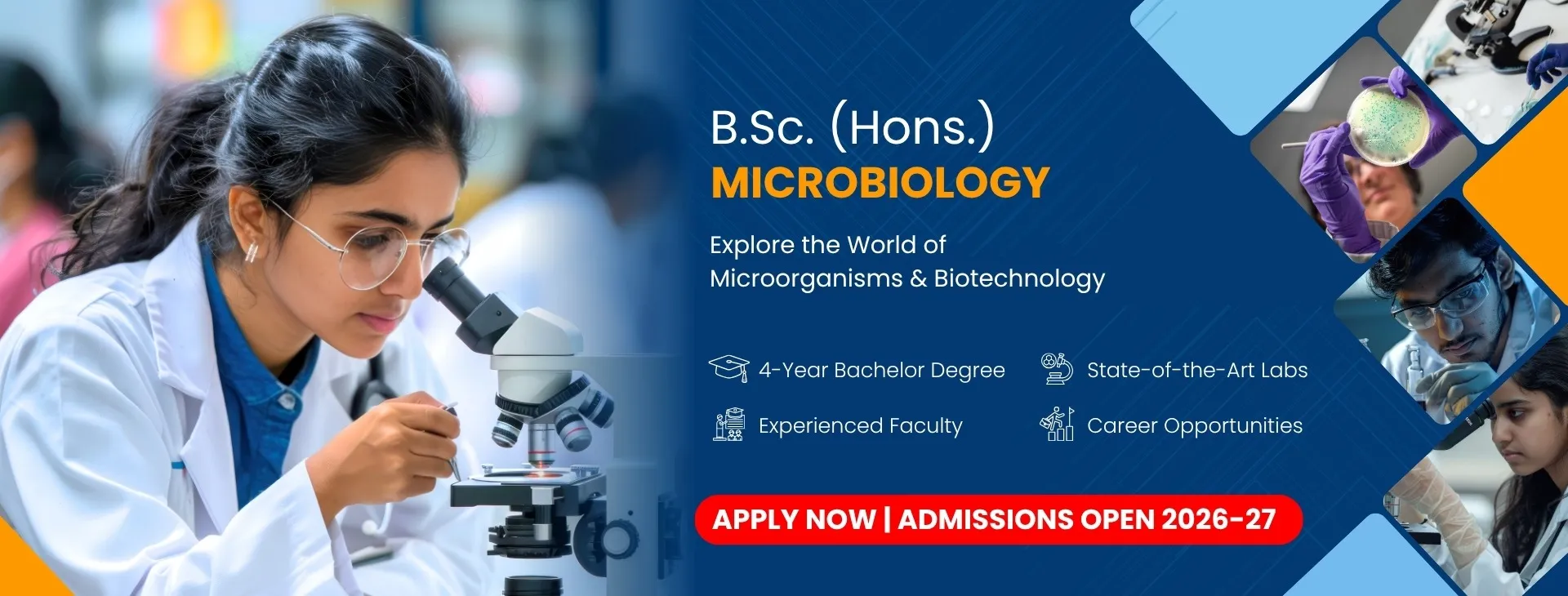
The Department of Microbiology at Indus University focuses on developing strong conceptual understanding, laboratory competence, and research aptitude in the field of microbiology. The department integrates theoretical knowledge with extensive laboratory training and interdisciplinary learning to prepare students for modern scientific challenges.
Aligned with the National Education Policy (NEP) 2020, the department promotes flexible learning pathways, multidisciplinary education, skill development, and research-driven learning. Students gain exposure to modern microbiological techniques, scientific inquiry, and industry applications.
The programme prepares students for higher studies, research careers, and professional opportunities in healthcare, biotechnology, environmental science, and industrial microbiology.
The B.Sc. (Honours) Microbiology programme is a four-year undergraduate degree divided into eight semesters. The programme provides a strong foundation in microbiological sciences, including microbial diversity, cell structure and function, microbial genetics, metabolism, and immunology.
The curriculum integrates theoretical knowledge with extensive laboratory practical training and interdisciplinary subjects. Students study core courses, discipline-specific electives, generic electives, and skill enhancement courses along with research-oriented coursework.
Under the Honours framework, students receive advanced laboratory exposure, research-based assignments, and project work that enable deeper understanding of microorganisms and their applications in health, environment, and biotechnology.
Students also undertake a research project or dissertation under faculty supervision, developing skills in experimental planning, microbiological techniques, data analysis, and scientific communication.
Highly qualified and experienced faculty.
Strong laboratory training and research exposure.
Flexible curriculum aligned with NEP 2020.
Emphasis on skill development and experiential learning.
Access to modern microbiology laboratory facilities.
Strong academic progression and placement support.
Microbial Diversity. Microbial Genetics. Microbial Physiology. Immunology. Microbial Ecology. Biochemistry.
Industrial Microbiology. Environmental Microbiology. Molecular Biology. Biotechnology Applications. Analytical and Laboratory Techniques.
The curriculum emphasizes research-based learning, laboratory experimentation, and scientific problem-solving.
Advanced microbiology laboratory training. Research-based projects and dissertations. Case studies and experimental analysis. Workshops and seminars. Laboratory problem-solving exercises.
Microbial isolation and identification. Laboratory techniques and analytical procedures. Scientific data analysis and interpretation. Research methodology and scientific reporting.
Graduates can pursue careers in scientific, healthcare, and biotechnology sectors.
Microbiologist. Research and Development Assistant. Quality Control Analyst. Clinical Laboratory Technician. Environmental Microbiologist. Bioprocess or Fermentation Technician.
Pharmaceutical and Biotechnology Industry. Healthcare and Diagnostic Laboratories. Environmental and Waste Management Sector. Food and Beverage Industry. Academic and Government Research Institutions.
Strong emphasis on laboratory-based training and research.
Exposure to modern microbiological instruments and techniques.
Curriculum aligned with national and international standards.
Opportunities for higher studies and research careers.
Multidisciplinary learning environment.
Students must have completed education from a recognized Higher Secondary Board.
Students must have passed 10+2 in the Science stream, typically with Biology or related science subjects.
Admission shall be conducted as per university norms based on merit and availability of seats.
4 Years (8 Semesters)
Students can apply online based on merit.
Candidates may also visit the campus directly, attend an interaction session, and receive approval from the Admission Committee.
The program duration is 3 Years (6 Semesters) for the standard degree, with a 4-Year Honours option available.
Candidates must have completed 10+2 in the Science stream with Biology or Biotechnology as a core subject.
The curriculum includes General Microbiology, Bacteriology, Virology, Immunology, Medical Microbiology, Industrial Microbiology, and Microbial Genetics.
Graduates can work as Microbiologists, Quality Control Executives, Lab Analysts, Clinical Research Associates, and Food Safety Officers in biotech, pharma, and food industries.
Indus University collaborates with an extensive network of top-tier corporate partners to provide exceptional career opportunities across multiple industries, featuring technology and IT leaders like Amazon, Oracle, Capgemini, e-Infochips, Synoptek, and Rishabh Software. Our engineering, automotive, and manufacturing recruiters include industry giants such as Tata Motors, Siemens, Audi, Kia, SKF, Bridgestone, POSCO, and Adani GAS, while the banking and insurance sectors are strongly represented by IndusInd Bank, IDFC First Bank, Capital First, Bajaj Allianz, and Apollo Munich Health Insurance. Additionally, our students secure dynamic roles with prominent organizations in healthcare, pharmaceuticals, and consumer retail, including Cadila Pharmaceuticals, eClinicalWorks, Godrej, JSW Paints, Decathlon, and Jaro Education, ensuring a comprehensive and robust placement ecosystem for all our graduates.